Innovation in Mental Health
May 5, 2026This month’s conversation explored mental health through a wide range of lenses — from housing and incarceration to herbalism, technology, storytelling, trauma, and community connection. What emerged was a reminder that mental health is deeply connected to the environments we move through, the systems we navigate, and the relationships that shape us.
At this month’s MIX, speakers challenged us to think about mental health not only as an individual issue, but as something shaped by systems, community conditions, access, and connection.
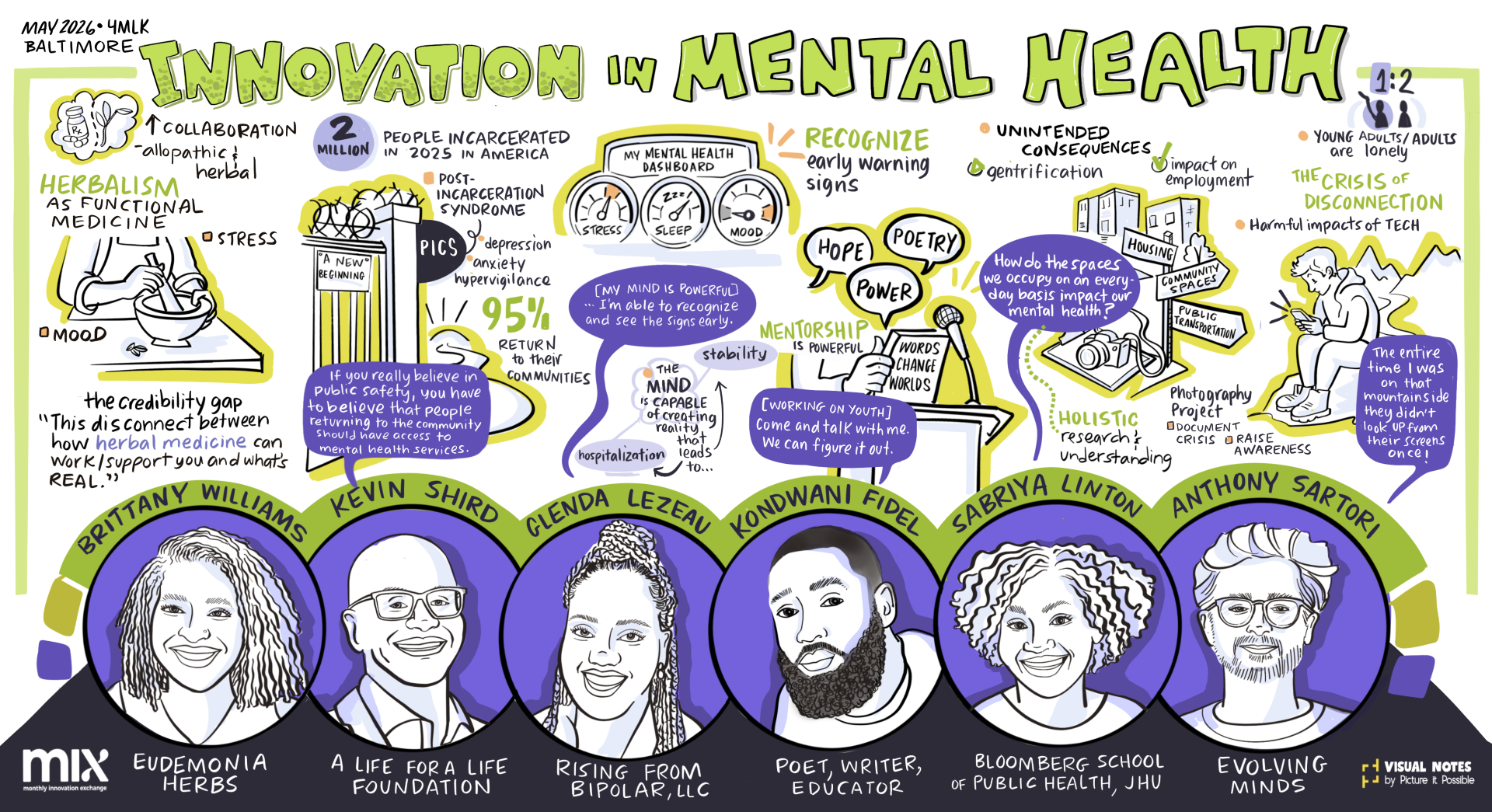
Sabriya Linton opened the conversation by exploring how housing, neighborhoods, and community development policies influence mental health outcomes. Her work looks at how affordability, displacement, revitalization, and lived experience intersect with wellbeing — and how communities themselves can become part of the solution.
Brittany Williams spoke about herbalism as both ancient practice and modern opportunity, particularly in supporting stress, sleep, nervous system regulation, and emotional wellbeing. She emphasized the importance of education, accessibility, and building stronger bridges between herbal and traditional medical approaches.
Anthony Sartori reflected on technology, loneliness, and disconnection through his long-running photography project documenting what the U.S. Surgeon General has described as an epidemic of isolation. His work highlighted how constantly mediated digital life can impact our ability to connect with one another and ourselves.
Kevin Shird brought attention to post-incarceration syndrome and the lasting mental health impacts of incarceration, trauma, and reentry. His remarks underscored that if communities care about both public health and public safety, they must also care about access to healing and support for returning citizens.
Glenda Lezeau shared her personal journey living with bipolar disorder and how learning to recognize early warning signs transformed her relationship with mental health. Through storytelling, vulnerability, and movement, she reminded the room of the power of self-awareness, support, and proactive care.
The evening concluded with reflections from Kondwani Fidel, who reminded us that sometimes a single interaction, comment, or act of encouragement can change the trajectory of a young person’s life. His message reinforced the importance of mentorship, presence, and showing up for one another in meaningful ways.
Across the evening, one theme kept surfacing: innovation in mental health is not just about treatment. It is also about relationships, environments, trust, belonging, and creating systems that help people feel seen, supported, and connected.